
Will Walking on a Torn Meniscus Make It Worse?

Medically Reviewed by
Dr. Hesham Al-Khateeb
FRCS (Orthopaedics) · UK Board-Certified
You twisted your knee during a run, felt a sharp pop during a game of basketball, or simply got up from a squat and something didn’t feel right. Now your knee is sore, slightly swollen, and you’re wondering, can I just walk it off? It’s one of the most common questions Dr. Hesham hears from patients, will walking on a torn meniscus make it worse?
The honest answer is, it depends. Should you walk on a torn meniscus? In most cases, not without getting it properly evaluated first. Continuing to stay active on an undiagnosed or untreated tear can absolutely make the injury worse.
Understanding why requires knowing exactly what the meniscus does, how it tears, and what happens inside your knee when you put weight on it before it has a chance to heal.

What is the meniscus and why does it matter?
The meniscus is a C-shaped piece of fibrocartilage that sits between your thighbone (femur) and shinbone (tibia) in the knee joint. Each knee has two of them, the medial meniscus on the inner side and the lateral meniscus on the outer side. Together, they act as shock absorbers, distribute your body weight evenly across the knee, and keep the joint stable during movement.
Think of them as cushioned pads that keep the bones in your knee from grinding against each other. When they’re healthy, you don’t notice them at all. When they’re torn, even simple movements can make the damage worse, and that’s when problems start to build up.
According to research, meniscus tears are among the most common knee injuries in the United States, with an estimated 850,000 meniscus surgeries performed each year. They affect people of all ages, from young athletes to older adults dealing with age-related cartilage degeneration.
Types of meniscus tears: Not all tears are the same
Before answering whether walking will make things worse, it helps to understand that not all meniscus tears behave the same way. Some are more stable and may tolerate light activity. Others tend to be fragile and can decline fast with any considerable strain.
Radial Tear – Cuts across the meniscus fibers, weakening its ability to absorb shock. These are common in younger, active individuals.
Horizontal Tear – Runs parallel to the tibial plateau and tends to appear with age-related degeneration. Often seen in adults over 40.
Longitudinal (Vertical) Tear – Runs along the length of the meniscus. These can extend into what’s called a “bucket-handle tear.”
Bucket-Handle Tear – A large, unstable tear where a portion of the meniscus flips into the joint like a displaced handle. This type can cause the knee to lock up entirely and is considered a serious injury that often needs surgical intervention.
Flap Tear – A portion of the meniscus peels away and can fold into the joint, causing pain and catching sensations.
Degenerative Tear – Most common in middle-aged and older adults, caused by gradual wear rather than a single traumatic event.
The type of tear you have significantly impacts whether walking will worsen the injury, which is exactly why getting a proper diagnosis matters before deciding to push through the pain.
So, will walking on a torn meniscus make it worse?
The short answer is yes, in many situations, walking on a torn meniscus can cause the tear to extend, worsen inflammation, and accelerate damage to the surrounding cartilage. Here’s what’s actually happening inside your knee when you walk on an injured meniscus:
Every time your foot hits the ground, your knee absorbs force. Normally, the meniscus distributes this load. When it’s torn, the damaged area can no longer do this efficiently. The torn edges may catch, move, or grind against the joint surfaces with each step. Over time, this repeated stress can:
Extend the length or depth of the existing tear
Cause the torn fragment to displace further into the joint
Damage the articular cartilage, the smooth surface that lines the knee bones
Trigger persistent inflammation, leading to chronic swelling and stiffness
Accelerate the onset of osteoarthritis in the affected knee
What makes this particularly tricky is that some people can still walk with a torn meniscus, and the pain may even feel manageable at first. Patients often come in asking, “Can I walk with a torn meniscus and just manage it on my own?” and while that’s understandable, being able to walk doesn’t mean the injury is stable. A tear that initially feels tolerable can progress significantly if the knee isn’t properly supported and rested.
A useful way to think about it: imagine a small tear in the fabric of your shirt. If you keep wearing it without repair, the tear grows larger and harder to fix. The same logic applies to a torn meniscus: delaying care doesn’t keep things neutral; it often tips the balance toward worse.
Symptoms that tell you something is seriously wrong
Many patients assume their knee pain will pass on its own. Sometimes mild strains do resolve. But meniscus injuries carry specific warning signs that shouldn’t be ignored. Here’s what to watch for:
Pain along the inner or outer knee line – particularly when twisting, squatting, or pivoting
Swelling that develops within 24-48 hours of an injury, or gradually over days
Stiffness and limited range of motion – difficulty fully bending or straightening the knee
Clicking, popping, or catching sensations during movement
The knee giving way – a feeling of instability or buckling
Locking – the knee getting stuck in one position, which can indicate a bucket-handle tear
If you’re experiencing any combination of these symptoms, continuing to walk without evaluation isn’t just uncomfortable; it could be making your injury significantly worse.
Read – How to Heal a Torn Meniscus Naturally?
What happens if you ignore a torn meniscus?
Ignoring a torn meniscus and walking on it without treatment is one of the more consequential mistakes patients make. The consequences tend to build quietly over weeks and months before they become severe.
In the short term, untreated meniscus tears lead to persistent swelling, increased pain, and reduced function. In the long term, the risks escalate considerably:
Cartilage damage: The meniscus protects the articular cartilage. When it can’t do its job, the cartilage surfaces begin to wear down, and unlike the meniscus, articular cartilage has virtually no capacity to heal on its own.
Early-onset osteoarthritis: Studies show that people who delay treatment for significant meniscus tears have a higher risk of developing knee osteoarthritis earlier in life. The knee essentially ages faster when its natural shock absorber is compromised.
Muscle weakening: Pain causes compensatory movement patterns. Over time, the muscles around the knee, particularly the quadriceps, weaken from disuse, making the joint even less stable.
More complex surgery: A small, stable tear that might have responded well to conservative treatment can, if ignored, progress into a large or displaced tear requiring more extensive surgical repair.
Can you make a torn meniscus worse? The activities that put you at risk
This is a question worth taking seriously. Yes, you absolutely can make a torn meniscus worse, and the activities that do the most damage aren’t always the obvious ones. Most people expect that running or jumping would aggravate the injury, and they’re right.
But for many patients, it’s the quieter, repeated stress of daily movement, going up stairs, rising from a low chair, walking longer distances than the knee can currently handle, that gradually deepens an existing tear.
A meniscus tear can get worse in several distinct ways depending on what you do after the injury:
The tear extends in length or depth: A small, peripheral tear that might have healed conservatively can become a much larger structural problem if the knee is repeatedly loaded without support. Each time the torn edge is compressed or rotated under body weight, there’s a real risk of the tear propagating further through the cartilage tissue.
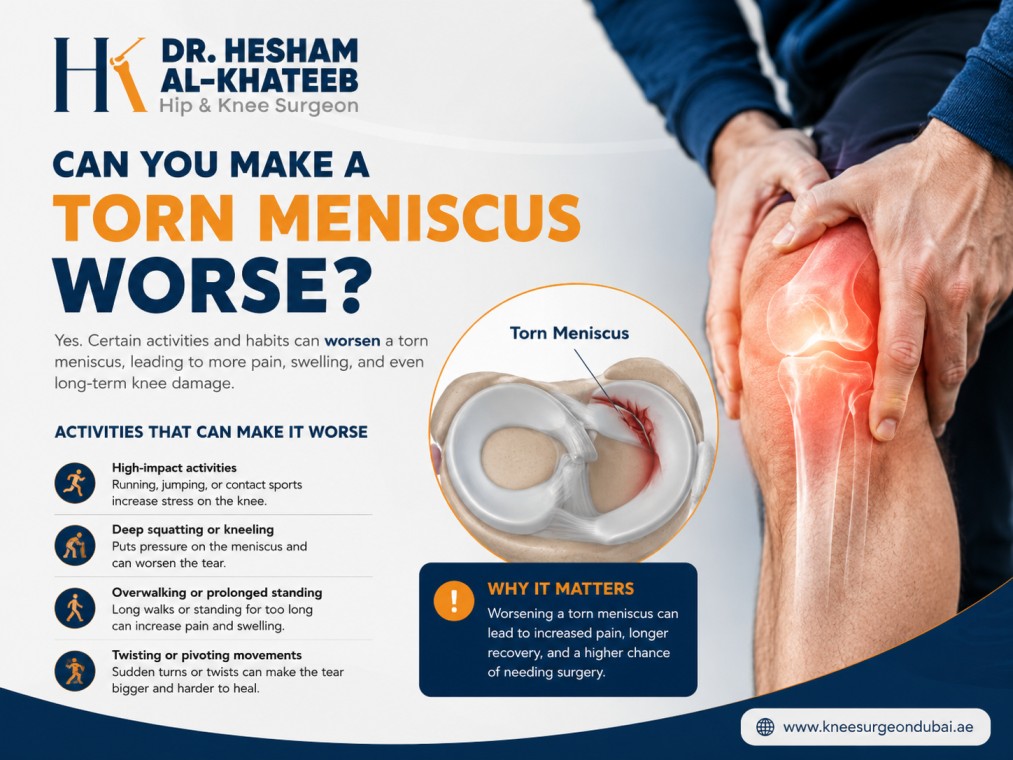
A stable tear becomes unstable: Some tears start out in a position where the meniscus still functions reasonably well. Continued activity, especially twisting, pivoting, or deep knee bends, can shift the torn fragment into the joint space, turning a manageable injury into one that causes locking, catching, and significant instability.
Surrounding cartilage deteriorates: The meniscus is essentially a buffer for your cartilage. Once it’s not working properly, the cartilage absorbs far more pressure than it should with every movement. That wear accumulates over time and, unfortunately, it’s not something the body can reverse on its own.
Chronic inflammation sets in: Repeated stress on a torn meniscus keeps the joint in a state of low-grade inflammation. Over time, this sustained swelling damages the synovial lining of the knee and accelerates degenerative changes throughout the joint.
A meniscus tear doesn’t always get worse in an obvious way. There’s rarely a sudden moment that gives it away, more often it’s gradual. The knee feels a little more swollen after a long day, a little stiffer each morning, a little shakier on the stairs.
Diagnosis: How is a torn meniscus identified?
A proper diagnosis is the first and most important step before making any decisions about activity. Dr. Hesham will typically begin with a thorough physical examination, assessing how you walk, where the pain is located, and how the knee responds to specific movements.
Common diagnostic tests include:
McMurray test – The doctor rotates and extends the knee to reproduce symptoms and assess the meniscus. | Thessaly test – You stand on the affected leg while rotating the knee, which loads the meniscus in a way that mimics normal walking stress. | X-ray – While it doesn’t show soft tissue, it helps rule out bone abnormalities or arthritis. | MRI (Magnetic resonance imaging) – The gold standard for confirming meniscus tears. An MRI gives detailed images of the soft tissue structures and helps classify the tear type, size, and location. |
Treatment options: From conservative to surgical
The good news is that not every meniscus tear requires surgery. Treatment depends heavily on the tear type, size, location, and the patient’s age, activity level, and overall knee health.
|
Treatment option |
Best for |
Expected timeline |
|
RICE (Rest, Ice, Compression, Elevation) |
Mild tears, initial management |
1-2 weeks for acute swelling |
|
Physical Therapy |
Stable tears, building knee strength |
6-12 weeks |
|
Anti-inflammatory Medication (NSAIDs) |
Pain and swelling management |
Short-term use |
|
Corticosteroid Injection |
Persistent inflammation |
Days to weeks of relief |
|
PRP (Platelet-Rich Plasma) Therapy |
Degenerative tears, adjunct healing |
4-8 weeks |
|
Meniscus Repair Surgery (Arthroscopic) |
Tears in vascularized zones in younger patients |
4-6 months recovery |
|
Partial Meniscectomy |
Irreparable tears, older patients |
6-12 weeks recovery |
Conservative treatment works well for small, stable tears particularly those in the outer third of the meniscus, which has a blood supply and greater healing potential. This approach typically involves a combination of rest, physical therapy, and activity modification.
Surgery comes into play when conservative treatment hasn’t worked, or when the knee keeps locking and giving way. Large, unstable tears may also need early intervention. The procedure itself is minimally invasive, done through small incisions with a tiny camera guiding the surgeon inside the joint.
Is walking good for a torn meniscus? When it can help vs. harm
This is one of the most nuanced questions in meniscus management, and one Dr. Hesham gets asked often. Patients want to know: is it ok to walk with a torn meniscus, or does any walking make things worse? The truth sits somewhere in the middle.
Complete bed rest is not the answer for most patients, but neither is pushing through significant pain. Walking with a torn meniscus is something many people do every day, often without realizing the injury exists, but whether that’s safe depends entirely on the tear type, severity, and your symptoms.
Light walking may be acceptable when:
The tear is small, stable, and diagnosed
There is minimal swelling and no locking
Your doctor has cleared you for gentle activity
You’re walking on flat surfaces with proper footwear
Walking becomes harmful when:
The knee is actively swollen, painful, or unstable
You’re walking on uneven terrain or inclines
The tear involves the inner (avascular) zone of the meniscus
There’s a bucket-handle or displaced tear
You’re attempting to return to running, sport, or high-impact movement prematurely
The key phrase here is symptom-guided activity. If walking produces sharp pain, causes your knee to swell, or makes the joint feel like it might give way, it’s your body’s signal to stop. Gentle movement within a pain-free range is generally fine; pushing through pain rarely is.
A question that comes up often alongside this is whether exercise in general is safe. Is it ok to exercise with a torn meniscus? The answer depends on what kind of exercise you have in mind. Low-impact movement, swimming, stationary cycling, and gentle range-of-motion work is often not only acceptable but actively encouraged as part of recovery.
On the other hand, patients who try to run with a torn meniscus before they’ve been cleared, or who return to heavy gym work too soon, often end up extending their injury timeline significantly.
What about a torn ACL and meniscus?
Some patients suffer a combined injury a torn ACL and meniscus together. This is more common than many realize, particularly in athletes who experience sudden pivoting or landing forces. People often wonder whether they can walk on a torn ACL and meniscus at the same time, and while many physically can, the joint instability created by losing both the ligament and cartilage support simultaneously is considerably greater than either injury alone.
If you’re in this situation and asking yourself whether you can walk with a torn ACL and meniscus, the more pressing question is really whether you should, and the answer from most orthopedic specialists is a firm no without proper evaluation and a structured management plan.
How to walk with a torn meniscus safely?
Until you can see a specialist, here are practical steps to protect your knee:
Use a walking aid – a cane or crutches reduce the load through your knee significantly
Wear a knee brace – a compression sleeve or hinged brace provides support and reduces instability
Avoid stairs and inclines – these dramatically increase compressive forces on the meniscus
Take anti-inflammatory medication – as directed by a healthcare provider, to manage swelling
Ice the knee – 15-20 minutes, 3-4 times daily, helps reduce inflammation
Avoid twisting movements – pivoting, rotating, and deep squatting are particularly aggravating for meniscus tears
Elevate when resting – keeping the leg raised reduces fluid accumulation in the joint
These are interim measures, not a substitute for professional evaluation and treatment.
Recovery expectations: What patients can realistically expect?
Once you’ve been diagnosed, prevention of further damage becomes a priority. Practical steps include:
- Strengthening the quadriceps, hamstrings, and hip muscles to offload stress from the knee
- Maintaining a healthy body weight every extra pound adds approximately 4 pounds of force to the knee joint
- Using appropriate footwear with proper cushioning and support
- Avoiding high-impact activities during the healing phase
- Following a structured rehabilitation program under guidance
Don't let a manageable injury become a major problem
Will walking on a torn meniscus make it worse? In most cases, yes particularly when the tear is significant, the knee is unstable, or there’s been no proper assessment. The meniscus is a critical structure, and continued mechanical stress on a damaged one doesn’t give it a chance to stabilize, let alone heal.
The good news is that with the right diagnosis and an individualized treatment plan, most people with meniscus tears go on to recover full function and return to the activities they love. Whether that path leads through conservative rehabilitation or surgery, early action consistently leads to better outcomes.
Frequently asked questions (FAQs) About Will Walking on a Torn Meniscus Make It Worse
Yes, many people can walk with a torn meniscus, especially if the tear is minor and stable. However, being able to walk doesn’t mean the injury is safe to ignore. Walking on an unstable or large tear can cause it to worsen over time and lead to cartilage damage.
There’s no set timeline it depends entirely on the tear type, size, and how much load you’re putting through the knee. A small, stable tear may remain manageable for weeks with minimal activity. A larger or unstable tear can worsen significantly within days of continued weight-bearing. This is why early evaluation matters.
Yes. High-impact activities like running, jumping, and heavy squatting can extend the tear, displace torn fragments, and accelerate damage to the joint’s cartilage lining. Even repeated walking on an unstable tear can gradually make the injury more complex and harder to treat.
Light walking is fine during recovery, as long as your doctor has given the go-ahead. Stick to flat surfaces, wear supportive shoes, and stop if it starts to hurt.
Many people can still walk with a combined ACL and meniscus tear, but the instability is significantly greater than with a meniscus tear alone. Walking on both injuries without treatment dramatically increases the risk of further joint damage and cartilage wear. Surgical evaluation is typically recommended for combined injuries, especially in active individuals.
Staying active during recovery is actually a good thing, as long as you’re choosing the right activities. Gentle options like swimming, stationary cycling, or targeted strengthening are usually safe and often part of the rehab plan. What to avoid, at least for now, is anything that puts sudden force through the knee: running, jumping, or sport-specific movement.
Yes, ignoring a meniscus tear can turn a minor injury into a much bigger problem. The surrounding cartilage wears down over time, and the chances of developing knee arthritis grow significantly.
Surgery is usually considered when rest and physiotherapy haven’t helped after 6–12 weeks, or if the knee keeps locking or giving way. A large or displaced tear on the MRI can also lean things toward surgery. Your specialist will do through scans, and will examine you in detail.
Yes, many people do. But with both structures damaged, your knee has very little to rely on for stability, so walking on it without treatment is risky and can quietly make both injuries worse over time.
About the author

Dr. Hesham Al-Khateeb
FRCS (Trauma & Orthopaedics) – UK
UK Board-Certified
15+ Years Experience
DHA Licensed – Dubai
Knee & Hip Specialist
Dr. Hesham Al-Khateeb is a UK board-certified orthopaedic surgeon specialising in knee and hip conditions, including knee replacement, ACL reconstruction, meniscus repair, cartilage restoration, and hip replacement surgery. Trained and certified in the United Kingdom, he brings internationally recognised surgical expertise to patients across Dubai and the GCC.
Currently practising at Emirates Hospitals Dubai, Dr. Hesham is known for personalised, evidence-based care — combining the latest minimally invasive and arthroscopic techniques with a focus on restoring long-term joint function and quality of life.
Medical Disclaimer
This article is for informational purposes only and is not a substitute for professional medical advice, diagnosis, or treatment. Always seek the advice of a qualified health provider with any questions you may have regarding a medical condition.
Medically reviewed by Dr. Hesham Al-Khateeb