
How Long After Knee Replacement Can You Drive

Medically Reviewed by
Dr. Hesham Al-Khateeb
FRCS (Orthopaedics) · UK Board-Certified
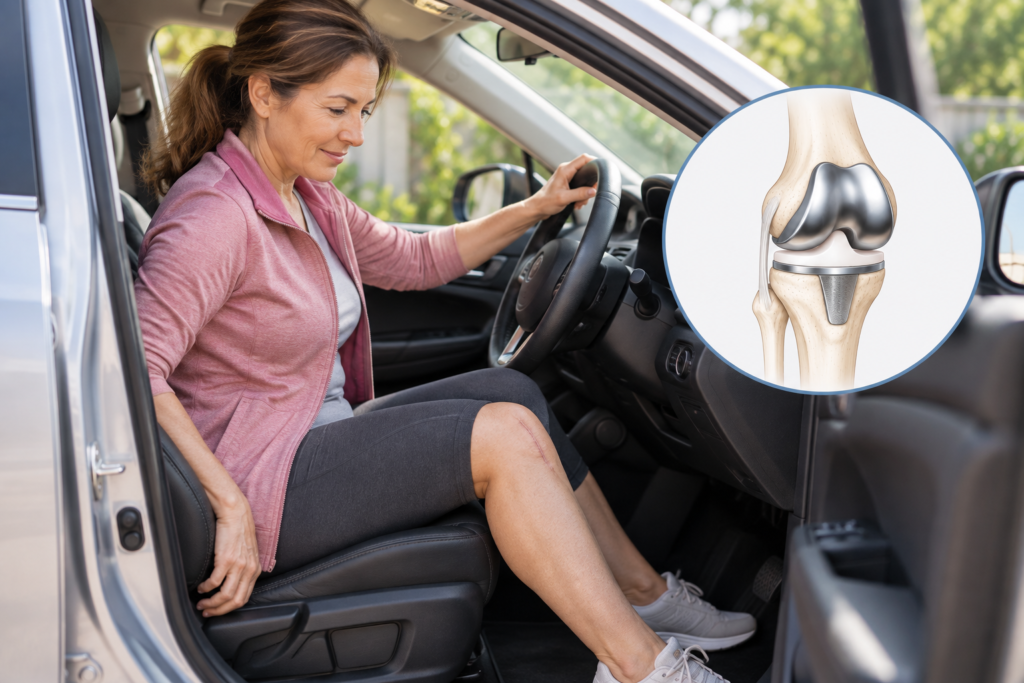
Getting back behind the wheel can feel like a major milestone after knee replacement surgery. It means greater independence, easier access to follow-up appointments, and a gradual return to everyday life. But how long after knee replacement can you drive safely? The answer is not based on the calendar alone.
When can you drive after knee replacement depends on which knee was operated on, how your body is healing, and whether your surgeon considers your strength, movement, and reaction time adequate, not simply how many weeks have passed.
At Dr. Hesham Al-Khateeb’s practice in Dubai, patients are guided through a personalized, milestone-based recovery plan rather than a generic countdown, which is exactly what this guide walks you through: realistic timelines, the factors that actually matter, and a simple way to check if you’re truly ready.
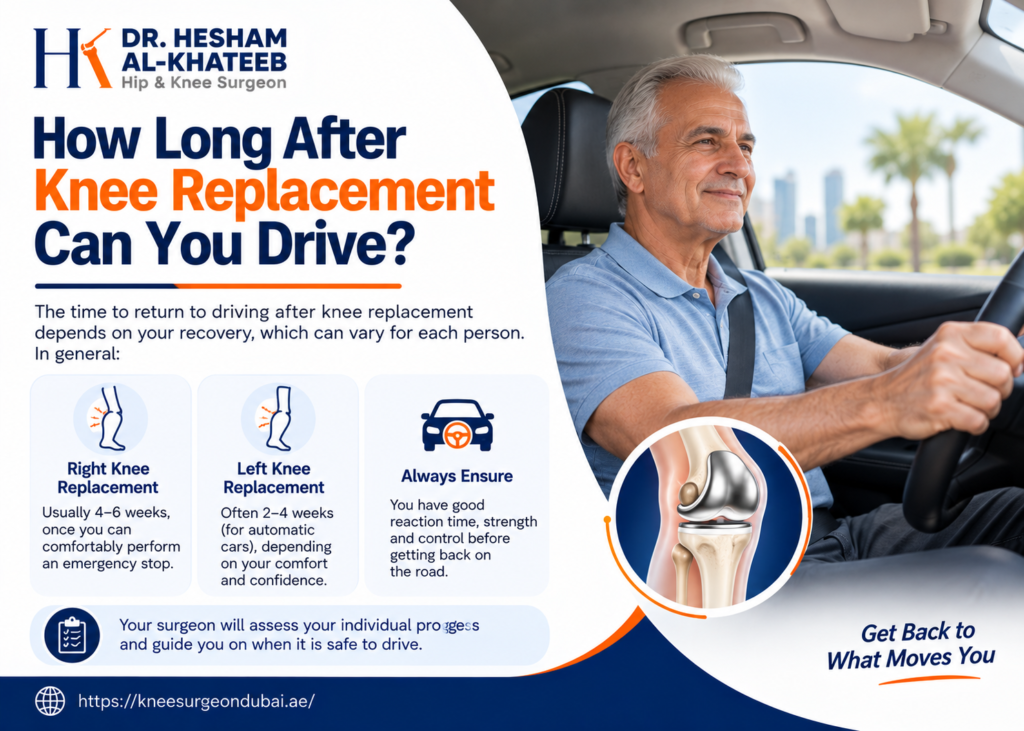
How long after knee replacement can you drive? The general timeline
There are a number of variables to recovery from a knee replacement surgery, but a realistic starting point for driving may be this:
- Left knee replacement (automatic transmission): Around 2-3 weeks, when pain is controlled and you can move without support.
- Right knee replacement: Typically 4 to 6 weeks, since the right leg controls the brake and accelerator and needs full strength and reaction speed before it’s safe.
- Manual transmission cars: 6-8 weeks, since clutch control requires more knee bending and more reflexes.
These ranges answer the common question of how many weeks after knee replacement can you drive, but think of them as a starting point for discussion with your surgeon, not a fixed finish line. Two patients who have surgery on the same day can be ready for very different weeks, depending on their healing rates and surgical techniques.
When to drive after knee replacement - Quick guide
Recovery factor | Why it matters |
Knee movement | Helps you enter, exit, and sit comfortably |
Muscle strength | Supports reliable pedal control |
Reaction time | Important for responding to hazards |
Braking ability | Essential for emergency stops |
Pain and swelling | Excessive discomfort can affect concentration |
Medication | Some pain medicines can impair alertness |
Type of vehicle | Manual and automatic cars place different demands on the legs |
Why the timeline isn't the same for everyone?
Several real, measurable factors determine when it’s actually safe to drive after a knee replacement — not just convenient.
Which knee was replaced – Since the right leg operates the brake pedal, a right knee replacement generally requires a longer wait before you can safely execute an emergency stop. | Surgical technique – The surgical approach is one factor that can influence recovery. Dr. Hesham uses minimally invasive and robotic-assisted techniques where appropriate, alongside personalized treatment planning, to support recovery and restoration of function. However, the timing of a return to driving still depends on the patient’s individual progress. |
Pain medication – You should be completely off opioid or sedating pain relievers before getting behind the wheel. Driving while on these medications isn’t just risky, it can also be a legal issue if you’re involved in an accident. | Strength and range of motion – You need enough bend in the knee to move comfortably between the accelerator and brake, and enough muscle control to react instantly. |
Does the side matter? Right knee vs. left knee
The operated knee has a real effect on driving after total knee replacement, mainly because of pedal control.
Right knee replacement: Needs particular attention, since the right leg commonly controls both the accelerator and brake. Before any return to driving after knee replacement, you’ll need to show reliable pedal control and the ability to brake quickly. | Left knee replacement: In an automatic car, the left leg generally isn’t operating the pedals, which can make getting in and out of the vehicle easier once you’re comfortable. That said, an earlier surgery date doesn’t mean an earlier green light for everyone, pain, mobility, and medication still matter. |
Automatic vs. manual: Does the car change the timeline?
Your vehicle plays a role in knee replacement recovery and driving too.
Automatic cars place fewer demands on the operated leg with no clutch pedal involved, while manual transmissions require repeated clutch use that can be difficult while the knee is still healing. Since most cars on UAE roads are automatic, many patients find their timeline a little more forgiving than in a manual-dominant market.
The 6-question readiness checklist
Before you turn the key, run through this quick self-check. It’s a simple way to judge knee replacement recovery and driving readiness beyond just counting weeks:
- Can I perform an emergency brake stop without hesitation, pain, or a delayed reaction?
- Have I stopped all sedating pain medication, including prescription opioids?
- Can I bend my knee comfortably enough to move freely between the pedals?
- Can I get into and out of the driver’s seat safely and comfortably?
- Can I move my leg and operate the pedals smoothly?
- Has my surgeon physically examined and cleared me to drive, rather than me simply assuming enough time has passed?
If you answered “no” to any of these, it’s worth holding off and checking in with your surgical team before you consider driving after total knee replacement.
* This checklist is not a substitute for medical clearance. It can help you identify whether you are physically feeling ready, but your surgeon should make the final decision about when it is safe for you to drive.
What happens if you drive too soon after knee replacement surgery?
It can be tempting to get back on the road early, but rushing your return to driving after knee replacement can come with real risks:
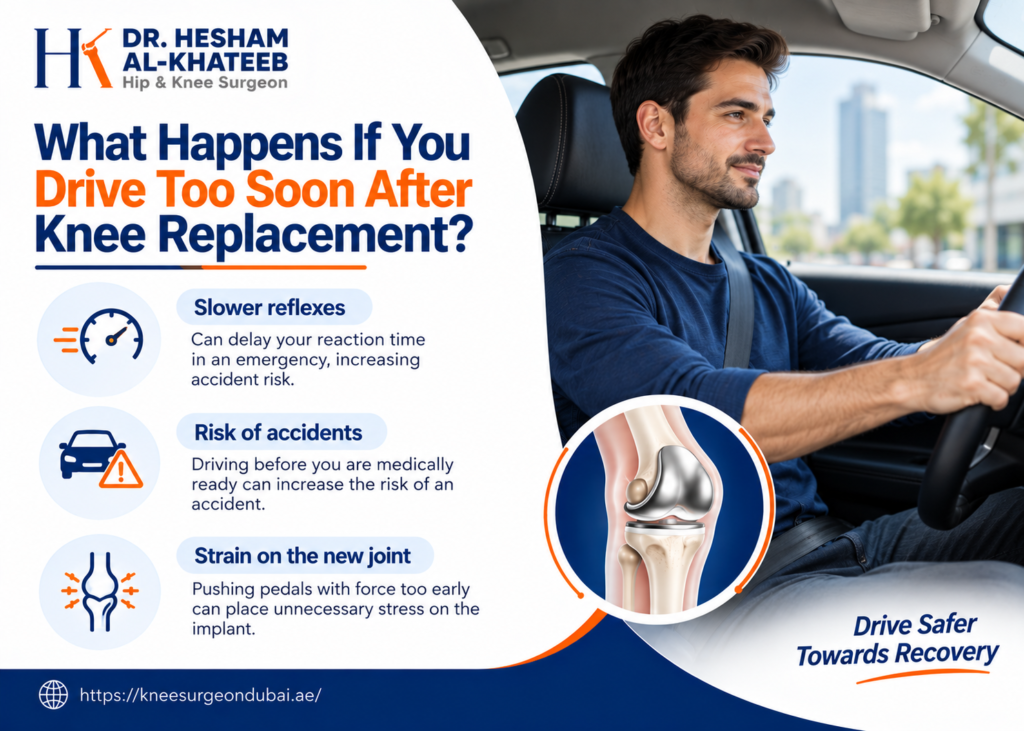
- Slower reflexes – can delay your reaction time in an emergency, increasing accident risk for you and others on the road.
- Risk of accidents – Driving before you are medically ready can increase the risk of an accident, particularly if pain, weakness, medication, or limited reaction speed affects your ability to control the vehicle.
- Strain on the new joint – Pushing pedals with force too early, before muscles and tissue have healed, can place unnecessary stress on the implant during a critical healing window.
Interestingly, reaction time after knee surgery has been studied by orthopedic researchers precisely because it doesn’t return to normal the moment pain fades, it’s a separate marker of recovery that surgeons assess independently of general mobility.
How Dr. Hesham Al-Khateeb's approach supports a faster, safer return
Driving after knee replacement surgery recovery timelines isn’t only about patience; they’re also influenced by how the surgery itself is performed.
Dr. Hesham Al-Khateeb, Consultant Knee Surgeon in Dubai, uses robotic-assisted techniques and custom-made implants designed around each patient’s own anatomy. This approach is associated with less soft-tissue disruption during surgery, which can support a more comfortable, milestone-driven recovery.
Rather than clearing patients based purely on a calendar date, Dr. Hesham evaluates gait, strength, reflexes, and comfort at each follow-up visit, so when you’re told it’s time, it’s based on how your knee is actually functioning, not just how many weeks have gone by.
Tips for getting back to driving safely
- Practice in a parked car first – Try to sit in the driver’s seat and check the pressure on the pedals and the comfort of the knee before starting the engine.
- Start small – Go for a short, quiet drive on your first return drive, not heavy traffic or long commute.
- Keep your follow-up appointments – They’re the best way to confirm your knee replacement driving restrictions have been lifted safely.
Ready to get back behind the wheel? Talk to Dubai's trusted knee replacement specialist
Recovery timelines are guidelines, but it’s the safest way to know exactly when you can drive after knee replacement is a personalized assessment from your surgeon. Dr. Hesham Al-Khateeb combines robotic-assisted precision with a recovery plan built around your body, not a generic calendar.
Book a consultation with Dr. Hesham Al-Khateeb today and get a clear, personalized timeline for your return to driving and everyday life.
FAQs
Many patients may return to driving within 2–6 weeks, but the exact timing depends on knee strength, movement, braking ability, medication, and surgeon clearance.
You may be able to drive after total knee replacement within a few weeks once you can safely operate the pedals, react quickly, and drive without medication-related impairment. difficulty bending, straightening, or putting weight on your knee.
Some patients may be ready around two weeks, particularly after certain left knee replacements with an automatic vehicle, but two weeks is not a universal clearance point.
Four weeks may be a reasonable timeframe for some patients, provided recovery is progressing well and you can comfortably control the vehicle and perform an emergency stop.
Right knee surgery may require particular caution because the operated leg usually controls the brake and accelerator. Your surgeon should assess strength, reflexes, and pedal control first.
Patients with left knee replacement may sometimes return sooner when driving an automatic car, but recovery, pain, medication, mobility, and individual safety still determine when driving is appropriate.
For a safe return to driving after knee replacement, avoid driving while taking strong pain medication that affects alertness or reaction time. Ask your surgeon when it is safe to drive based on your medication and recovery.
About the author

Dr. Hesham Al-Khateeb
FRCS (Trauma & Orthopaedics) – UK
UK Board-Certified
15+ Years Experience
DHA Licensed – Dubai
Knee & Hip Specialist
Dr. Hesham Al-Khateeb is a UK board-certified orthopaedic surgeon specialising in knee and hip conditions, including knee replacement, ACL reconstruction, meniscus repair, cartilage restoration, and hip replacement surgery. Trained and certified in the United Kingdom, he brings internationally recognised surgical expertise to patients across Dubai and the GCC.
Currently practising at Emirates Hospitals Dubai, Dr. Hesham is known for personalised, evidence-based care — combining the latest minimally invasive and arthroscopic techniques with a focus on restoring long-term joint function and quality of life.
Medical Disclaimer
his article is for informational purposes only and is not a substitute for professional medical advice, diagnosis, or treatment. Always seek the advice of a qualified health provider with any questions you may have regarding a medical condition.
Medically reviewed by Dr. Hesham Al-Khateeb