
Knee Replacement Surgery
Medically reviewed by Dr. Hesham Al-Khateeb, Consultant Orthopaedic Surgeon, FRCS (Tr & Orth), with 20+ years of clinical experience and specialist expertise in hip and knee replacement surgery. | Last medically reviewed: 4 November 2026.

20+ Years of Experience

UK-Trained Orthopedic Surgeon

Fellowship Training in Canada, Germany & the USA

2000+ Robotic-Assisted & Custom Joint Replacement

Fluency in Arabic & English
20+ Years of Experience
UK-Trained Orthopedic Surgeon
Fellowship Training in Canada, Germany & the USA
2000+ Robotic-Assisted & Custom Joint Replacement
Fluency in Arabic & English
Knee replacement surgery in Dubai is a procedure that replaces a damaged knee joint with an artificial implant to reduce pain and improve movement. Knee replacement is typically considered for advanced arthritis when non-surgical treatment has not helped. Dr. Hesham Al-Khateeb, Orthopedic Surgery Consultant, performs knee replacement at Emirates Hospital Jumeirah and Emirates Specialty Hospital in Dubai.
Key facts about Knee Replacement in Dubai with Dr. Hesham Al-Khateeb
Key facts about Knee Replacement in Dubai with Dr. Hesham Al-Khateeb
Specialist:
Dr. Hesham Al-Khateeb, Consultant in Orthopaedic Surgery with specialist training in knee and hip surgery.
Qualifications:
FRCS (Tr & Orth), UK Certificate of Completion of Training in Orthopaedics, and an Adult Reconstruction Fellowship in Canada.
Hospitals:
Emirates Hospital Jumeirah and Emirates Specialty Hospital.
Hospitals:
Emirates Hospital Jumeirah and Emirates Specialty Hospital.
Treatment options:
Total or partial knee replacement, depending on the extent and location of joint damage.
Treatment options:
Total or partial knee replacement, depending on the extent and location of joint damage.
Recovery:
Early mobilisation and physiotherapy help improve knee movement, strength and function.
Personalized care:
Treatment planning considers your symptoms, joint condition, activity level and recovery goals.
Consultation:
Discuss the benefits, risks, alternatives and expected recovery before deciding whether surgery is right for you.
Dr. Hesham Al-Khateeb, an Orthopedic Surgery Consultant trained at the Royal National Orthopaedic Hospital in London and in an Adult Reconstruction Fellowship in Canada, has 20+ years of clinical experience. The knee replacement program covers assessment, imaging, surgery, rehabilitation and follow-up. Patients and families comparing options for knee replacement surgery in Dubai, including those seeking a second opinion, can use this page to review the procedure, risks, cost and recovery.
What is Knee Replacement Surgery?
Knee replacement surgery, or knee arthroplasty, is a procedure that replaces worn joint surfaces with an artificial implant, performed under anesthesia in a hospital. The goal of knee replacement is to reduce pain and improve movement in a knee damaged by arthritis. Osteoarthritis is a common reason for the operation.
- A knee implant typically has three parts:
- A metal component on the end of the thigh bone,
- A metal tray on the top of the shin bone, and
- A plastic spacer that glides between them.
In some patients, the back of the kneecap is also resurfaced with a plastic button.
Knee replacement does not restore the original natural joint. Some patients continue to experience stiffness, altered sensation, or difficulty kneeling after surgery. Dr. Hesham Al-Khateeb should explain the likely benefits and limitations based on your examination and imaging.
Why is a Knee Replacement needed?
Knee replacement is needed when advanced arthritis or joint damage causes pain and stiffness that limit daily life despite non-surgical treatment.
Osteoarthritis is a common cause, while rheumatoid arthritis and injury-related damage are less frequent causes. Whether knee replacement suits you is confirmed at the consultation.
- Symptoms that may lead a surgeon to consider knee replacement include:
- Stiffness that makes bending or straightening the knee difficult
- Pain that interferes with walking, standing, or sleeping
- Advanced joint damage on X-ray or MRI
- Knee pain that persists at rest or at night
- A knee that feels unstable or gives way
- Visible deformity, such as a bowed leg
Dr. Hesham Al-Khateeb assesses symptoms together with examination and imaging, because pain level alone does not decide whether surgery is appropriate. Many patients try activity changes, medication, injections and physiotherapy before knee replacement is discussed.
What types of Knee Replacement are available in Dubai?
Knee replacement surgery in Dubai comes in two main types, each tailored to address specific conditions and degrees of knee damage:
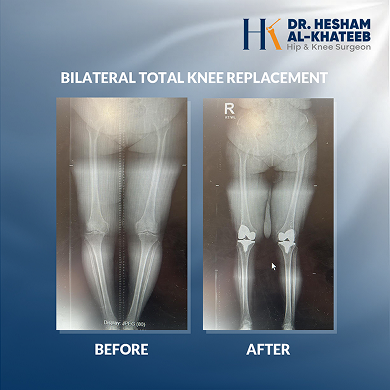
- Total knee replacement: Replaces the damaged surfaces across the main compartments of the knee.
- Partial knee replacement: Replaces the affected compartment while preserving suitable parts of the natural joint.
- Revision knee replacement: Replaces or revises an existing implant because of problems such as loosening, wear, infection, or instability.
Total knee replacement Dubai may be appropriate when arthritis affects multiple compartments. Partial replacement may be an option when damage is limited, and the remaining joint structures meet the required criteria.
Revision surgery can involve more complex planning than a first replacement. Implant availability, surgical techniques, and hospital facilities should be confirmed with the clinic before describing specific options as available in Dubai.
How is Knee Replacement Surgery performed in Dubai?
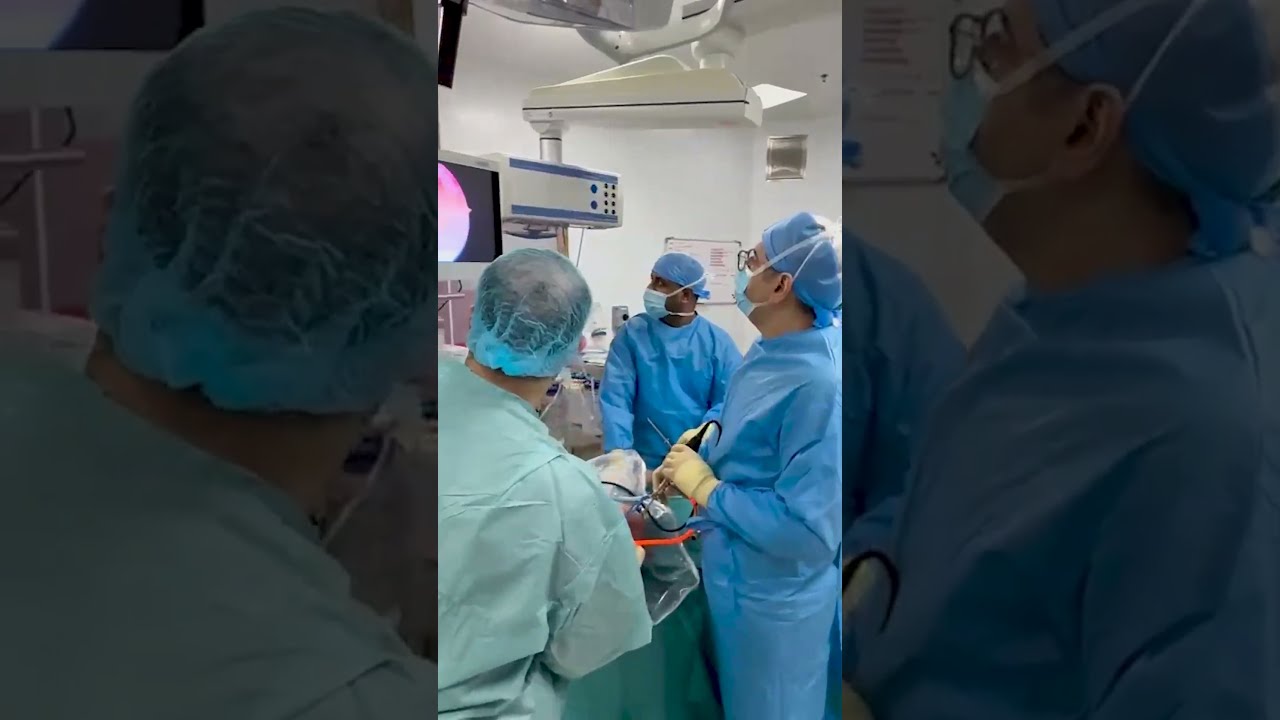
Knee replacement surgery is performed in a hospital under spinal or general anesthesia. The knee replacement surgeon in Dubai removes the damaged joint surfaces, shapes the bone, fits the implant components and closes the incision. Operating time is typically 60 to 120 minutes, and hospital stay is typically 3 days.
Knee replacement in Dubai follows these steps, adapted to each patient:
Consultation and examination:
Your surgeon reviews your symptoms, medical history, medications, walking ability, and treatment goals.
Imaging and pre-operative checks:
Knee X-rays help show the extent of joint damage and guide surgical planning. Additional tests may be needed to check your general health before surgery.
Anesthesia administration:
Regional anesthesia (spinal block with nerve block) or general anesthesia is administered to eliminate pain during and immediately after the operation.
Incision:
An incision is made over the front of the knee to expose the damaged joint surfaces while protecting adjacent nerves and blood vessels.
Bone resection and preparation:
Specialized alignment guides are used to remove damaged cartilage and a small amount of underlying bone from the femur and tibia.
Implant trialing and fixation:
Trial components are inserted to test joint stability, leg alignment, and range of motion before final metal and plastic implants are secured, usually with bone cement.
Closure and layered dressing:
The surgical incision is meticulously closed in layers, a sterile compression dressing is applied, and the patient is transferred to the recovery unit for monitoring.
Am I a candidate for Knee Replacement surgery in Dubai?
You may be a candidate for knee replacement if advanced arthritis causes ongoing pain and limits daily activity despite non-surgical treatment. Candidacy for knee replacement surgery in Dubai is confirmed at consultation after examination and imaging. Fitness for anesthesia is assessed before surgery.
- Factors that may support knee replacement include:
- Advanced joint damage on X-ray or MRI
- Pain that disturbs sleep or limits walking and stairs
- Limited benefit from medication, injections or physiotherapy
- Good general health for anesthesia and recovery
- Readiness to follow a rehabilitation program
- Factors that may make knee replacement unsuitable, or may need further assessment first, include:
- Active infection in the knee or elsewhere in the body
- Medical conditions that raise anesthesia risk until treated, such as uncontrolled heart or lung disease
- Mild joint damage that may still respond to non-surgical care
- Expectations that surgery will return the knee to its condition before the onset of arthritis
Age alone does not decide candidacy. Dr. Hesham Al-Khateeb considers joint damage, general health and personal goals together, and a second opinion is welcome.
What are the benefits of Knee Replacement?
Knee replacement can reduce arthritis pain, improve mobility, and make walking, climbing stairs, and daily tasks easier for many patients. Benefits depend on the condition of the knee before surgery, general health and rehabilitation. Individual results vary, and eligibility is confirmed at consultation.
Benefits that patients and surgeons aim for with knee replacement include:
- Less knee pain: Replacing damaged joint surfaces can reduce pain caused by advanced arthritis.
- Easier movement: With less pain and regular physiotherapy, walking, standing and climbing stairs may become more manageable.
- Greater independence: Everyday activities may become easier to manage without as much help from others.
- Less need for pain medication: Some patients can reduce their use of pain relief after recovery, under medical guidance.
- Improved knee alignment: Surgery can correct certain deformities caused by advanced arthritis.
- A replaced knee may feel different from a natural knee, and knee replacement does not restore a joint to its condition before arthritis. Rehabilitation, body weight, age and other health conditions all influence how much benefit a patient gains. Dr. Hesham Al-Khateeb discusses realistic expectations for your knee before any decision, and results vary between patients.
What are the risks and limitations of Knee Replacement?
Knee replacement is a major surgery, and risks include infection, blood clots, stiffness, ongoing pain, implant wear or loosening, and anesthesia-related complications. Knee replacement also has limits, because an artificial knee may not feel or move exactly like a natural knee. Dr. Hesham Al-Khateeb discusses personal risks at consultation before any decision.
Risks of knee replacement that Dr. Hesham Al-Khateeb reviews with each patient include:
- Infection in the wound or around the implant, which may need antibiotics or further surgery
- Blood clots in the leg veins, which can travel to the lungs, so preventive measures are used after surgery
- Stiffness or limited bending, which may need extra physiotherapy or a further procedure
- Ongoing pain in some patients, even when the implant is well placed
- Implant wear or loosening over time, which may lead to revision of the knee replacement
- Injury to nerves or blood vessels, which is uncommon
- Reactions to anesthesia or medicines
Limitations of knee replacement matter as much as risks. Knee replacement does not cure arthritis in other joints, does not restore the knee to its condition before arthritis, and may restrict high-impact sports and kneeling. Smoking, body weight and other health conditions can raise risk.
How long does a Knee Replacement last?
Data published in The Lancet in 2019 found that approximately 82% of total and 70% of partial knee replacements last 25 years. Lifespan varies with age, weight, activity and implant type. Dr. Hesham Al-Khateeb discusses the expected durability for your knee at the consultation.
The Lancet figures come from pooled data from national joint registries, including the Finnish registry. Registry figures describe groups of patients, not individual knees, and the authors noted that more information is needed to predict how long a specific knee replacement will last.
Factors that can affect how long a knee replacement lasts include age at surgery, body weight, activity level, implant design and surgical technique. A knee replacement that wears out or loosens can often be treated with a revision knee replacement.
How much is a Knee Replacement in Dubai?
Knee replacement surgery cost Dubai range from AED 85,000 to AED 120,000, depending on the implant and procedure type. Insurance may cover part of the cost when clinical criteria are met.
- Factors that influence knee replacement cost in Dubai include:
- Type of procedure: total, partial or revision knee replacement
- Implant design and brand
- Hospital, room category and length of stay
- Anesthesia and operating team
- Pre-operative tests and imaging
- Rehabilitation sessions and follow-up visits
- Treatment of any complication or extra procedure
- Insurance coverage for knee replacement depends on the policy, the insurer and clinical criteria such as documented arthritis and unsuccessful non-surgical care. Pre-authorization from the insurer is typically needed before surgery.
What are the alternatives to Knee Replacement?
Alternatives to knee replacement include weight management, physiotherapy, pain medication, injections and, in selected patients, joint-preserving surgery such as osteotomy or partial knee replacement. Non-surgical care is usually tried first. The right option depends on joint damage, age and goals, and is confirmed at consultation.
Non-surgical options considered before knee replacement include:
Exercise and physiotherapy:
Strengthening the muscles around the knee can support function and movement.
Medication:
An appropriate pain-relief or anti-inflammatory medication may help manage symptoms. Risks and interactions should be reviewed.
Joint-preserving surgery:
Certain procedures may suit selected patients, but they are not appropriate for every pattern of arthritis.
Joint-preserving surgery:
Certain procedures may suit selected patients, but they are not appropriate for every pattern of arthritis.
Activity changes:
Adjusting high-impact activities and pacing demanding tasks may reduce symptom flare-ups.
Activity changes:
Adjusting high-impact activities and pacing demanding tasks may reduce symptom flare-ups.
Weight management:
If relevant, weight management may reduce stress on the knee and improve function.
Injections:
Selected injections may be discussed, depending on the condition and expected benefits.
Walking aids:
A suitable cane or other aid may improve stability and ease movement.
- Joint-preserving surgical options for selected patients include:
- Arthroscopy to address specific problems, such as a meniscus tear, rather than widespread arthritic changes.
- Osteotomy to realign the bone and reduce pressure on the affected area of the knee.
- Partial knee replacement when arthritis is confined to one section of the joint.
- Knee replacement is usually considered when alternatives have not given enough relief. Dr. Hesham Al-Khateeb explains which options fit your knee, and a second opinion is welcome.
Total vs partial knee replacement: Which suits me?
Total knee replacement Dubai resurfaces the whole knee joint, while partial knee replacement resurfaces one damaged compartment. Neither type is better in general. Suitability depends on the pattern of joint damage, ligament condition, age and activity level, and is chosen at consultation.
The table below compares total and partial knee replacement:
Feature | Total knee replacement | Partial knee replacement |
What is replaced | Surfaces of the whole joint | One damaged compartment |
Typical suitability | Damage extends beyond one suitable compartment | Damage limited to one compartment, with healthy ligaments |
Full recovery | Several months or longer (NHS) | Typically shorter than total (NHS) |
Wait before driving | At least 6 weeks (NHS) | At least 3 weeks (NHS) |
Registry survival at 25 years | Approximately 82% (The Lancet, 2019) | Approximately 70% (The Lancet, 2019) |
Partial knee replacement in Dubai may suit patients with damage in one compartment, while total knee replacement in Dubai may suit damage across the joint. Dr. Hesham Al-Khateeb recommends a type after examination and imaging.
What is recovery like after knee replacement in Dubai?
Recovery after knee replacement in Dubai typically involves 2-3 nights in hospital, early walking with a physiotherapist and several months of rehabilitation. The NHS advises waiting at least 6 weeks before driving after a total knee replacement. Individual results vary.
The table below gives a general idea of what to expect after surgery:
Stage | Typical timing | What happens |
In hospital | Up to 3 days | Begin standing and walking with a walker or crutches, manage pain and start gentle knee exercises. |
First weeks at home | Daily routine mostly resumed within about 6 weeks | Gradually increase daily activities, progress to a cane if appropriate, work on knee bending and monitor wound healing. |
Driving | At least 6 weeks after total and 3 weeks after partial knee replacement | Return to driving only when you can control the vehicle safely and your surgeon agrees. |
Return to work | About 6 to 12 weeks, depending on the job | Return gradually, depending on your recovery and whether your job involves desk work, prolonged standing or physical activity. |
Full recovery | Several months or longer | Strength, flexibility and mobility continue to improve with rehabilitation. |
Physical therapy after knee replacement typically starts within 24 hours of surgery and continues for at least 2 months, depending on your progress and rehabilitation needs. Following the exercise plan early supports long-term strength and movement.
Common precautions after knee replacement include:
- Avoid twisting the knee, bending down and reaching up as much as possible. - Do not kneel on the new knee until the surgeon says it is safe. - Do not sleep with a pillow under the knee. - Avoid standing for long periods, which can cause ankle swelling.
Can overseas and other emirate patients have a Knee Replacement in Dubai?
Patients from other emirates and from overseas can have a knee replacement in Dubai under Dr. Hesham Al-Khateeb. Patients from Abu Dhabi and the northern emirates travel to the Dubai clinic and are treated under DHA regulation. Overseas patients should plan consultation, surgery and follow-up around the recovery timeline.
Overseas patients typically stay in Dubai for a few days after surgery before flying, so that the surgical team can review the wound and early movement. Air travel after knee replacement can raise the risk of blood clots, so Dr. Hesham Al-Khateeb gives travel advice before discharge.

Why choose Dr. Hesham Al-Khateeb for a Knee Replacement in Dubai?
Dr. Hesham Al-Khateeb is a Consultant in Orthopaedic Surgery with specialist training in knee and hip procedures. He holds FRCS (Tr & Orth), has completed UK specialist training in orthopaedics, and undertook an Adult Reconstruction Fellowship in Canada. Knee replacement surgery is available at Emirates Hospital Jumeirah and Emirates Specialty Hospital.
- Evidence-based surgical approaches: Treatment is tailored to the patient’s joint condition, anatomy, and functional needs, with consideration for joint movement and soft-tissue preservation.
- Individual treatment plans: Your care plan covers pre-operative assessment, surgical preparation and post-operative management based on your condition.
- Rehabilitation support: Recovery planning includes rehabilitation suited to the patient’s progress and mobility goals.
- Clear communication: Dr. Hesham explains the available treatment options, potential risks and expected recovery to help patients make informed decisions.
Frequently Asked Questions about Knee Replacement Dubai
Answers below cover cost, safety, hospital stay, candidacy, recovery, implant lifespan, total versus partial replacement, choosing a surgeon, insurance and non-surgical options. Each answer about knee replacement in Dubai can be read on its own, and suitability is always confirmed at the consultation.
Knee replacement in Dubai costs AED 85,000 and AED 120,000. Implant type, procedure type, hospital room and length of stay influence the final price. Insurance may cover part of the cost when clinical criteria are met.
Knee replacement surgery in Dubai is a major surgery with risks, performed by a DHA licensed surgeon in a hospital setting. Risks include infection, blood clots, stiffness and implant wear, and risks for your knee are discussed at consultation. Safety depends on health, surgical planning and rehabilitation.
Knee replacement usually takes 1 to 2 hours, depending on the complexity of the procedure. Most patients stay in the hospital for 2 to 4 nights for pain control, post-surgical monitoring and initial physiotherapy.
A good candidate for knee replacement typically has advanced joint damage, ongoing pain and limited function despite non-surgical care, and is fit for anesthesia. Suitability for knee replacement is confirmed at consultation after examination and imaging.
The knee replacement recovery timeline typically includes 2-3 nights in hospital, early walking with physiotherapy and several months of rehabilitation. The NHS advises waiting at least 6 weeks before driving after a total knee replacement. Return to work is usually after about 6 to 12 weeks, depending on the job
Total or partial knee replacement is chosen at consultation based on which parts of the knee are damaged, the condition of the ligaments, age, and activity level. Neither type is better in general. Partial knee replacement suits damage in one compartment, while total knee replacement suits damage across the joint.
Choosing a knee surgeon in Dubai starts with objective checks: a valid DHA license, specialist orthopedic qualification, knee replacement experience and hospital facilities. Patients can also ask any knee replacement doctor Dubai to explain risks, alternatives and expected recovery.
Knee replacement removes and replaces the damaged joint surfaces to relieve arthritis-related pain and improve mobility. It does not treat arthritis in other joints, and some pain or stiffness may persist after surgery.
Health insurance plans in Dubai frequently cover knee replacement surgery when advanced joint destruction and failure of conservative management are documented. The clinic surgical team assists patients with pre-authorization documentation required by insurance providers prior to booking surgery.
Knee pain from arthritis can often be treated without knee replacement using weight management, exercise, physiotherapy, medication, and injections. Knee replacement is considered when non-surgical care no longer controls pain or function.
You can expect some pain and swelling, wound care, assisted walking and physiotherapy. Recovery times vary, and your surgical team will guide your rehabilitation and return to everyday activities.
Avoid strenuous activities and high-impact exercise until your surgical team approves them. Follow wound care and rehabilitation instructions, and seek medical advice for worsening pain, redness, discharge, or fever.
Book a Knee Replacement consultation in Dubai
During your initial knee replacement consultation in Dubai, Dr. Hesham Al-Khateeb will perform a comprehensive orthopedic examination, review your medical history, and evaluate weight-bearing X-rays of your knee joint.
Dr. Hesham Al-Khateeb will discuss non-surgical treatment options, confirm whether you are a candidate for knee replacement surgery in Dubai, and design a personalized treatment plan.
Consultations are available at Emirates Hospital Jumeirah and Emirates Specialty Hospital. Contact the clinical appointments team directly or book online to arrange your specialist orthopedic assessment.