
Exercises for Hip Replacement After 3 Months

Medically Reviewed by
Dr. Hesham Al-Khateeb
FRCS (Orthopaedics) · UK Board-Certified

If you are three months into your hip replacement recovery, you may be wondering what hip replacement exercises you can safely do at this stage. For many patients, three months after hip replacement is a time when strength, mobility, and confidence are gradually improving. However, recovery is not the same for everyone, and your activity level should depend on your healing and the surgeon’s advice.
So, can I exercise 3 months after hip replacement? In many cases, patients can progress to more challenging exercises by this stage, provided their recovery is progressing normally. Walking, low-impact cardiovascular exercise, mobility work, and progressive strengthening may all form part of a rehabilitation programme.
Dr. Hesham Al-Khateeb assesses and treats patients with hip and knee conditions, helping them progress through recovery according to their individual needs and functional goals.
What is Hip Replacement Surgery?
Hip replacement surgery replaces a damaged hip joint with an artificial joint to relieve pain and improve movement. The replacement components can be made from materials such as metal, ceramic, or plastic, depending on the implant selected.
The procedure is generally performed to reduce pain and improve movement when the hip has been significantly affected by conditions such as arthritis, injury, or joint damage. Rehabilitation after surgery then focuses on helping you safely return to everyday activities.
What does physical therapy involve?
Physical therapy is an important part of hip replacement recovery. It may begin in the hospital and continue for several weeks or months, depending on your progress and individual needs. Depending on your mobility and level of support, rehabilitation may take place in:
- An inpatient rehabilitation facility, with regular supervised therapy before returning home.
- Your home is where a physical therapist visits you for scheduled sessions.
- An outpatient rehabilitation centre, where you attend therapy appointments.
As your strength and mobility improve, therapy can move from basic movement and balance work to strengthening and functional exercises. You may also be given after hip surgery exercises to continue at home between sessions. The amount of supervised therapy you need will depend on your progress and may decrease as you become more independent.
How can exercises help after Hip Replacement Surgery?
Your hip replacement exercises will be adjusted to your stage of recovery and physical abilities. In general, they aim to help you:
- Improve balance and stability around your new hip
- Strengthen the muscles that support hip movement, including the flexors, extensors, and abductors
- Gradually restore your hip’s functional range of motion
As your recovery progresses, strength training after hip replacement can help rebuild the muscles needed for walking, balance, and everyday activities.
Recommended exercises after Total Hip Replacement Surgery
There is no single exercise programme that is suitable for everyone after hip replacement. Dr. Hesham Al-Khateeb may adjust exercises based on your strength, mobility, surgical approach, and progress.
- Walking
Walking is one of the simplest hip replacement recovery exercises. As your strength and endurance improve, you can gradually increase your walking distance and pace.
- Stationary cycling
A stationary bike can provide low-impact cardiovascular exercise while allowing controlled hip movement. Adjust the seat so that your hip and knee are positioned comfortably and avoid forcing the movement.
- Step-ups
Step-ups can build strength in the muscles around the hip while improving the leg strength needed for everyday activities. Start with a low step and use slow, controlled movements.
- Bridges
Bridges work the gluteal muscles and other muscles that support the hip and pelvis. As your strength improves, your therapist may gradually increase the challenge.
- Squats
Can you squat after hip replacement? In many cases, partial or supported squats may be introduced during rehabilitation. However, passing the three-month mark does not automatically mean you can perform deep squats. Your ability to squat safely depends on your strength, mobility, surgical precautions, and overall recovery.
What exercises to do after a Hip Replacement at 3 months?
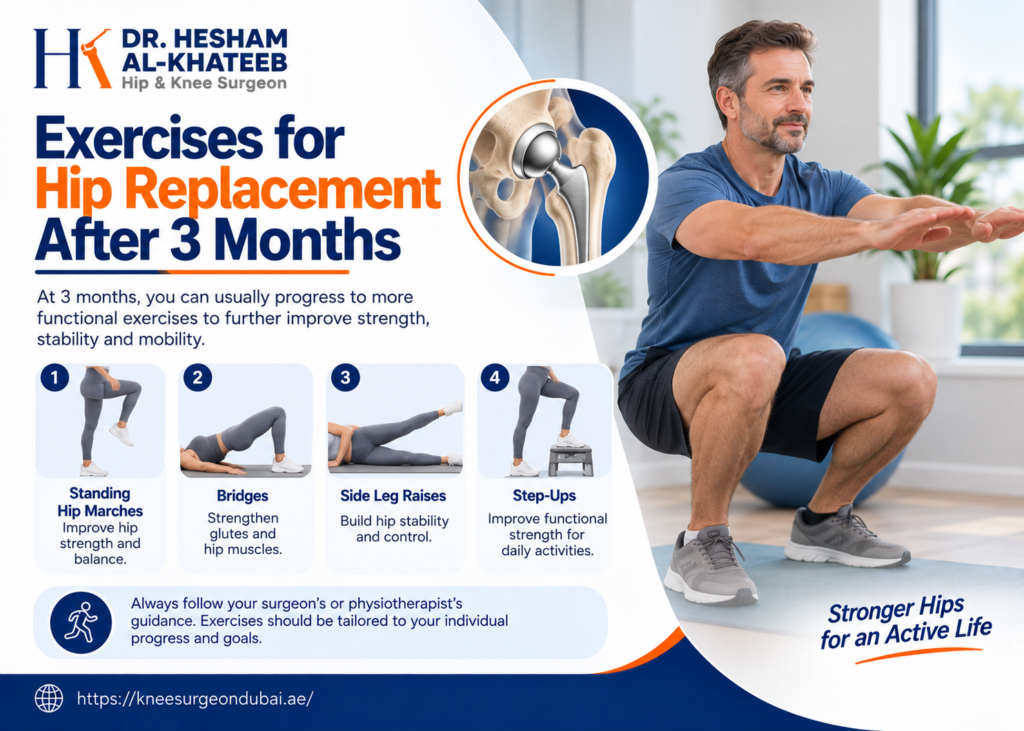
At around three months, your hip may be ready for more progressive exercises, depending on your recovery. Common 3 months after hip replacement exercises may include:
- Bridge progression
- Squat progression
- Step-up progression
- Deadlift progression
- Split-squat progression
- Hip abduction/side plank
- Hip flexion
The aim is to gradually improve hip strength, balance, flexibility, and endurance without placing excessive stress on the joint.
Exercises to avoid after Hip Replacement
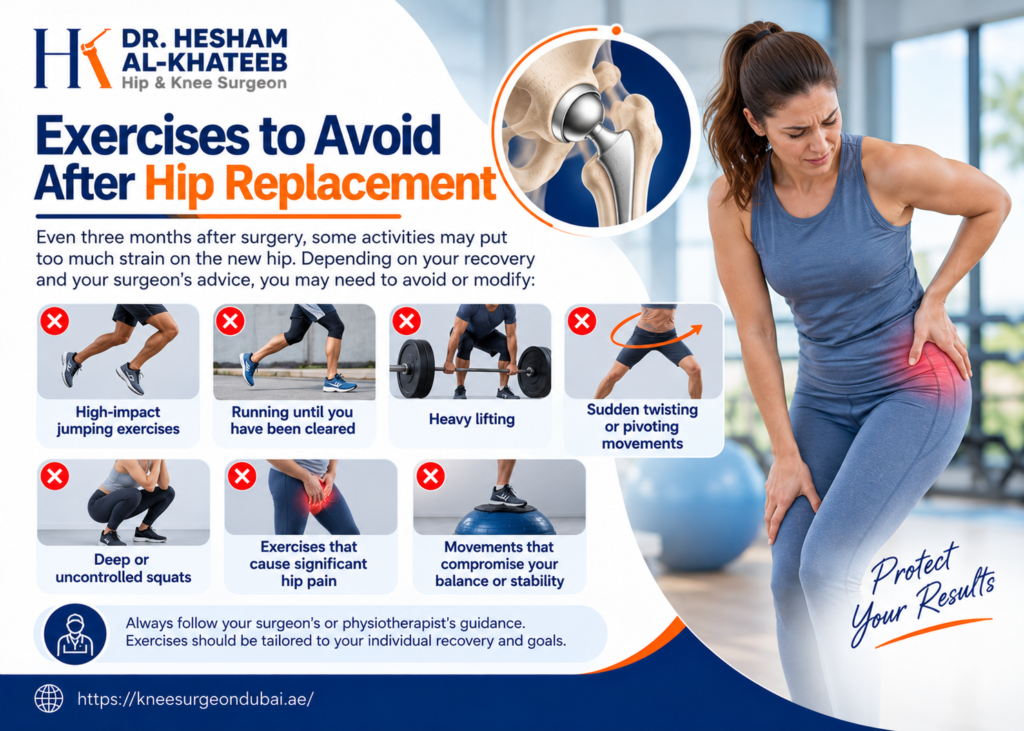
Even three months after surgery, some activities may put too much strain on the new hip. Depending on your recovery and your surgeon’s instructions, you may need to avoid or modify:
- High-impact jumping exercises
- Running until you have been cleared
- Heavy lifting
- Sudden twisting or pivoting movements
- Deep or uncontrolled squats
- Exercises that cause significant hip pain
- Movements that compromise your balance or stability
Your surgeon can advise when specific activities can be safely introduced.
What should Hip Replacement recovery look like at 3 months?
Hip replacement recovery continues beyond the first few weeks. By three months, many patients have improved walking ability and strength, but some may still experience stiffness, weakness, or reduced endurance.
Progress should be gradual. If an exercise causes increasing pain, significant swelling, instability, or a noticeable deterioration in function, stop the activity and seek medical advice.
The goal of exercises after total hip replacement is not simply to increase the amount of exercise you can perform. It is to restore useful movement and strength while allowing the hip to continue recovering.
Why choose Dr. Hesham Al-Khateeb?
Returning to exercise after hip replacement requires an approach that considers your individual recovery rather than following a fixed timeline.
Dr. Hesham Al-Khateeb provides assessment and treatment for hip and knee conditions, with treatment plans tailored to the patient’s symptoms, physical function, lifestyle, and recovery goals.
Patients may benefit from:
- Individualised treatment planning – Exercise and recovery recommendations are adapted to each patient’s needs and progress.
- Focus on mobility and function – Treatment aims to help patients regain movement and return to daily activities.
- Advanced surgical techniques – Minimally invasive and modern surgical approaches may be considered where appropriate.
- Rehabilitation-focused care – Recovery involves progressing strength, movement, and function safely after surgery.
Get back to exercise safely after Hip Replacement
Three months after hip replacement can be an important stage in rebuilding strength and confidence. Walking, cycling, controlled strengthening, and other low-impact activities may be appropriate for many patients, while higher-impact or heavier exercises may require further progression.
If you are unsure which hip replacement exercises after hip replacement surgery are appropriate for you, schedule a consultation with Dr. Hesham Al-Khateeb to discuss your recovery and activity goals.
FAQs
At three months, some patients may be ready for walking, cycling, step-ups, bridges, controlled squats, and progressive strengthening. The right exercises depend on your recovery, strength, mobility, and your surgeon’s advice.
In many cases, you can gradually increase your activity by this stage if your recovery is progressing well. Your surgeon or physiotherapist can advise when to increase the intensity and which activities are suitable.
Some patients may be able to perform controlled partial squats during rehabilitation. Deeper or heavier squats should be introduced only when your surgeon or physiotherapist confirms that they are appropriate for you.
You may be wondering, can I go to the gym 3 months after hip replacement? Many patients can return to the gym around this time, starting with low-impact activities and controlled resistance exercises. More demanding activities, including heavy lifting and jumping, may require additional recovery time.
Some high-impact or demanding movements may need to be avoided or modified during recovery. These can include jumping, running, heavy lifting, sudden twisting, and deep squats. Your surgeon can advise when it is appropriate to add them back into your routine.
About the author

Dr. Hesham Al-Khateeb
FRCS (Trauma & Orthopaedics) – UK
UK Board-Certified
15+ Years Experience
DHA Licensed – Dubai
Knee & Hip Specialist
Dr. Hesham Al-Khateeb is a UK board-certified orthopaedic surgeon specialising in knee and hip conditions, including knee replacement, ACL reconstruction, meniscus repair, cartilage restoration, and hip replacement surgery. Trained and certified in the United Kingdom, he brings internationally recognised surgical expertise to patients across Dubai and the GCC.
Currently practising at Emirates Hospitals Dubai, Dr. Hesham is known for personalised, evidence-based care — combining the latest minimally invasive and arthroscopic techniques with a focus on restoring long-term joint function and quality of life.
Medical Disclaimer
his article is for informational purposes only and is not a substitute for professional medical advice, diagnosis, or treatment. Always seek the advice of a qualified health provider with any questions you may have regarding a medical condition.
Medically reviewed by Dr. Hesham Al-Khateeb