
Knee Pain When Climbing Stairs: Causes & Treatment

Medically Reviewed by
Dr. Hesham Al-Khateeb
FRCS (Orthopaedics) · UK Board-Certified
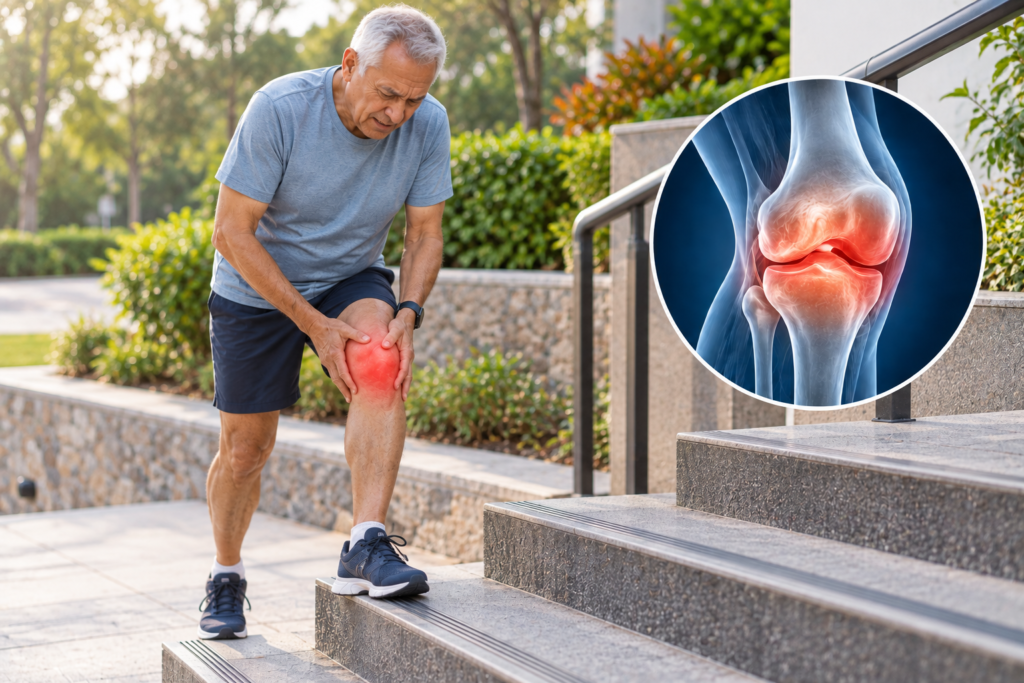
You walk across a room just fine. Then you reach the stairs, and there it is again – that familiar ache or sharp twinge. If knee pain when climbing stairs has become part of your routine, you’re not imagining it, Knee pain when climbing stairs is a common reason people seek orthopedic care, and it’s often an early sign that the knee needs attention.
Dr. Hesham Al-Khateeb, a leading knee, hip, and sports medicine surgeon in Dubai, hears this exact complaint every week. He specializes in offering unique joint-preserving treatment, sporty injury management, robotic-assisted knee replacement, and minimally invasive arthroscopic surgery. Uncover the real cause of knee pain rather than treating symptoms.
This blog covers the causes of knee pain when climbing stairs, the warning signs to watch for, and the best treatment for knee pain when climbing stairs.
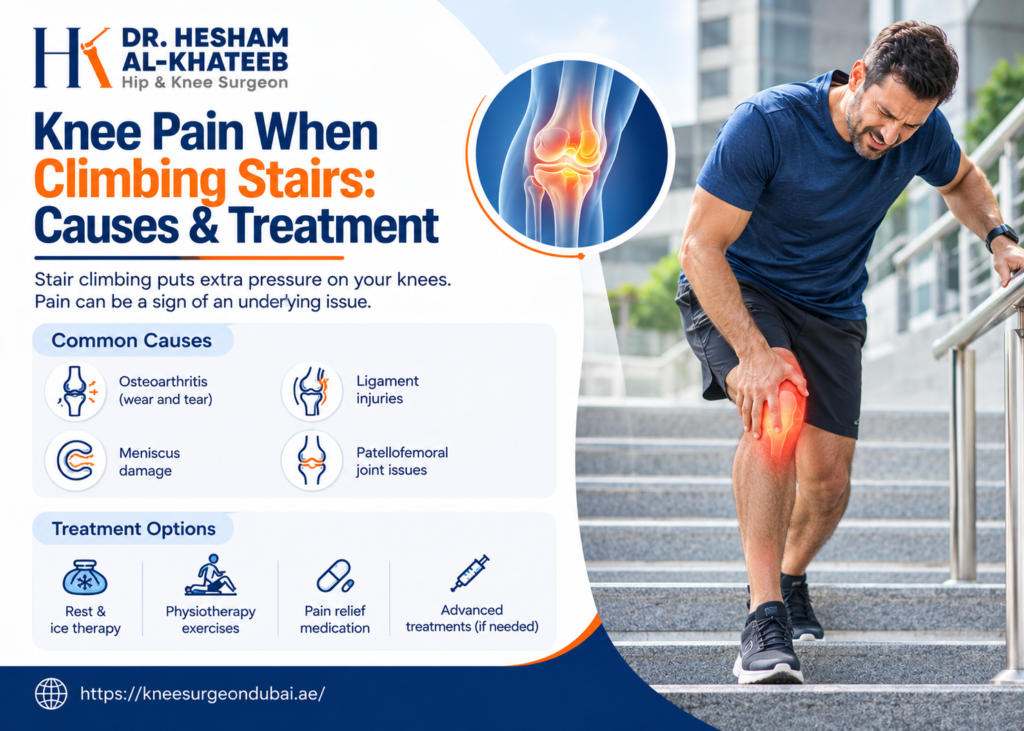
Why do your knees hurt more on stairs than on flat ground?
Many people wonder, “Why does my knee hurt when I climb stairs?” The answer lies in how your knee works. Stairs require more strain than walking on a flat ground.
Every step bends the knee deeper and shifts more weight behind the kneecap.
- Flat ground: your knee carries roughly your body weight.
- Climbing stairs: pressure behind the kneecap can rise to three or four times your body weight.
- Walking down stairs: the load can be even higher, since your knee absorbs each step rather than pushing you forward.
That’s a real biomechanical fact – it’s why flat ground feels fine while stairs bring on knee pain on stairs almost instantly.
Quick Fact – The knee is one of the largest and hardest-working joints in the body. It absorbs significant force during everyday movements, especially when climbing stairs, making it more vulnerable to injury and wear over time. |
Going up vs. Going down: Why your knee hurts differently
The location of your pain can offer useful clues about what may be causing it. While it doesn’t replace a medical evaluation, it can help you understand why knee pain on stairs varies from person to person.
If your knee hurts going up stairs, the pain usually sits at the front of the knee, where the kneecap meets the thighbone – often patellofemoral pain or tendon irritation. | If it’s worse walking down, it more often points to cartilage wear, a meniscus tear, or ligament trouble, since the knee absorbs more shock on the way down. |
A quick self-check: Where does the pain occur?
Where You Feel the Pain | Possible Cause |
Around the kneecap | Patellofemoral pain syndrome (runner’s knee) |
Inside of the knee | Meniscus injury or early osteoarthritis |
Outside of the knee | Iliotibial (IT) band irritation |
Below the kneecap | Patellar tendon irritation (jumper’s knee) |
Deep inside the joint | Cartilage damage or arthritis |
Many describe knee pain while walking upstairs as a dull ache, while pain going down feels sharper. Telling your doctor which direction hurts more helps narrow down the cause faster.
Sharp knee pain when climbing stairs: When it's more than soreness
A little stiffness after a long day is normal. Sharp knee pain when climbing stairs, alongside other symptoms, is not. Watch for:
- Sudden, sharp pain with every step
- Swelling that doesn’t ease after a day or two
- Clicking, popping, or locking in the knee
- A feeling that your knee might “give way”
- Pain in knee when climbing stairs that lingers beyond two weeks, even with rest
Sharp knee pain when climbing stairs is not a result of tired muscle, but points to a structural issue.
Why stairs are extra tough on knees in everyday Dubai life?
A few everyday habits can make knee pain on stairs show up sooner than expected:
Marble and tiled staircases, common in villas and towers, offer less grip and add strain with every step. | Long desk hours, on the other hand, weaken the muscles that support the knee over time. |
Daily prayer involves deep knee bending, which can quietly aggravate a sensitive knee. | An active lifestyle, padel, the gym, weekend runs, is great for health, but a sudden jump in activity can bring on pain fast. |
How Dr. Hesham Al-Khateeb diagnoses your knee pain?
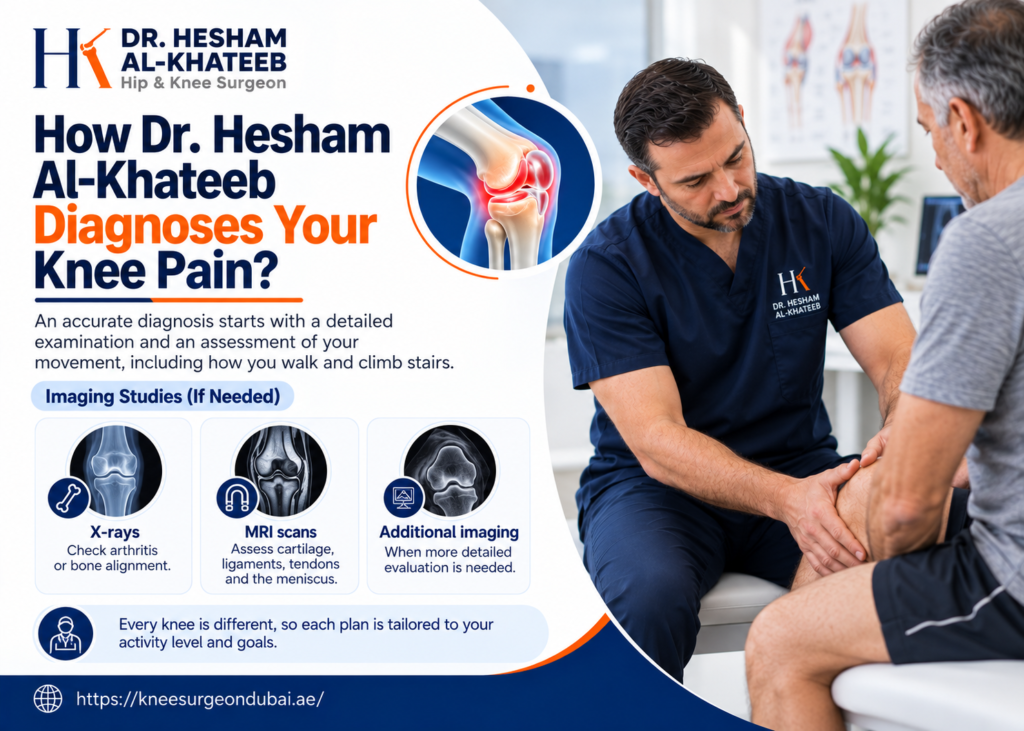
An accurate diagnosis comes first: a hands-on exam to find where your pain in knee when climbing stairs is coming from, a review of your walking and stair pattern.
Apart from the above, depending on your symptoms, imaging studies may also be recommended, including:
- X-rays to evaluate arthritis or bone alignment
- MRI scans to assess cartilage, ligaments, tendons, and the meniscus
- Additional imaging when more detailed evaluation is needed
Every knee is different, so each plan fits your movement, activity level, and goals.
What is the best treatment for knee pain when climbing stairs?
The best treatment for knee pain when climbing stairs depends on the underlying cause, your age, activity level, and the severity of the condition, but most cases follow a similar path.
Conservative treatments can provide excellent results when started early.
Physical therapy for the quadriceps | Hamstrings, and hip muscles | Small adjustments to stair-climbing technique |
Anti-inflammatory support | Bracing when needed | Weight management to ease pressure on the joint |
When surgery may be recommended? When surgery may be recommended?
When that isn’t enough, Dr. Hesham offers minimally invasive arthroscopic surgery, meniscus or ligament repair, and robotic-assisted procedures with custom implants – built to get you back to daily life, prayer, and sport, pain-free.’
Arthroscopic knee surgery for meniscus tears, cartilage injuries, or ligament problems | Ligament reconstruction for unstable knees |
Cartilage preservation procedures when suitable | Robotic-assisted knee replacement for advanced arthritis that significantly limits daily life |
What are the simple ways to prevent knee pain on stairs?
A few consistent habits help keep knee pain on stairs from coming back:
- Strengthen your quads, hamstrings, and glutes a few times a week
- Choose supportive, well-cushioned shoes
- Warm up before exercise or a long day on your feet
- Use the handrail on steep or unfamiliar stairs
- Avoid sudden jumps in activity level, and maintain a healthy weight
These small changes matter most once you notice knee pain while walking upstairs, even before it becomes a bigger problem.
Why choose Dr. Hesham Al-Khateeb for knee pain treatment?
British-trained surgeon with fellowship training in Canada, Germany, and the USA | Individualized treatment plans built around your movement, activity, and lifestyle, not one-size-fits-all care |
Advanced surgical options, including minimally invasive and robotic-assisted procedures with custom implants | Trusted knee, hip, and sports medicine specialist with clinics in Dubai and Bahrain |
Your next step: Lasting relief for knee pain when climbing stairs
Knee pain when climbing stairs is common, but it isn’t something to simply accept. With the right diagnosis and a plan built around your lifestyle, most people find lasting relief, whether that’s a few weeks of physical therapy or a more advanced procedure with an experienced surgeon.
Relieve pain and restore mobility. It’s time to book a consultation with Dr. Hesham Al-Khateeb today!
FAQs
Not always, but it can be. Osteoarthritis is a common cause of knee pain on stairs, especially over age 50. Younger patients get it too, often from muscle imbalances or old injuries. An accurate diagnosis is the only way to know for sure.
Going downstairs puts more pressure on your knee than going up, since it must absorb your body weight with every step. This often points to cartilage wear, a meniscus tear, or ligament instability rather than simple fatigue.
Yes. Weak quadriceps, hamstrings, or hip muscles change how your kneecap moves, adding strain with every step. It’s one of the most common and most treatable causes of knee pain when climbing stairs.
Straight leg raises, wall sits, step-ups, and gentle glute exercises can help. It’s best to confirm the cause of your pain in knee when climbing stairs first, since the wrong exercise can worsen certain conditions.
If your pain lasts for more than 2 weeks, causing swelling, instability, locking sensation, or limiting daily movement, seek an immediate consultation with Dr. Hesham. Early evaluation can stop small issues from becoming bigger ones.
About the author

Dr. Hesham Al-Khateeb
FRCS (Trauma & Orthopaedics) – UK
UK Board-Certified
15+ Years Experience
DHA Licensed – Dubai
Knee & Hip Specialist
Dr. Hesham Al-Khateeb is a UK board-certified orthopaedic surgeon specialising in knee and hip conditions, including knee replacement, ACL reconstruction, meniscus repair, cartilage restoration, and hip replacement surgery. Trained and certified in the United Kingdom, he brings internationally recognised surgical expertise to patients across Dubai and the GCC.
Currently practising at Emirates Hospitals Dubai, Dr. Hesham is known for personalised, evidence-based care — combining the latest minimally invasive and arthroscopic techniques with a focus on restoring long-term joint function and quality of life.
Medical Disclaimer
his article is for informational purposes only and is not a substitute for professional medical advice, diagnosis, or treatment. Always seek the advice of a qualified health provider with any questions you may have regarding a medical condition.
Medically reviewed by Dr. Hesham Al-Khateeb